Certified Web Developer Python AI Training Institute in Himachal Pradesh
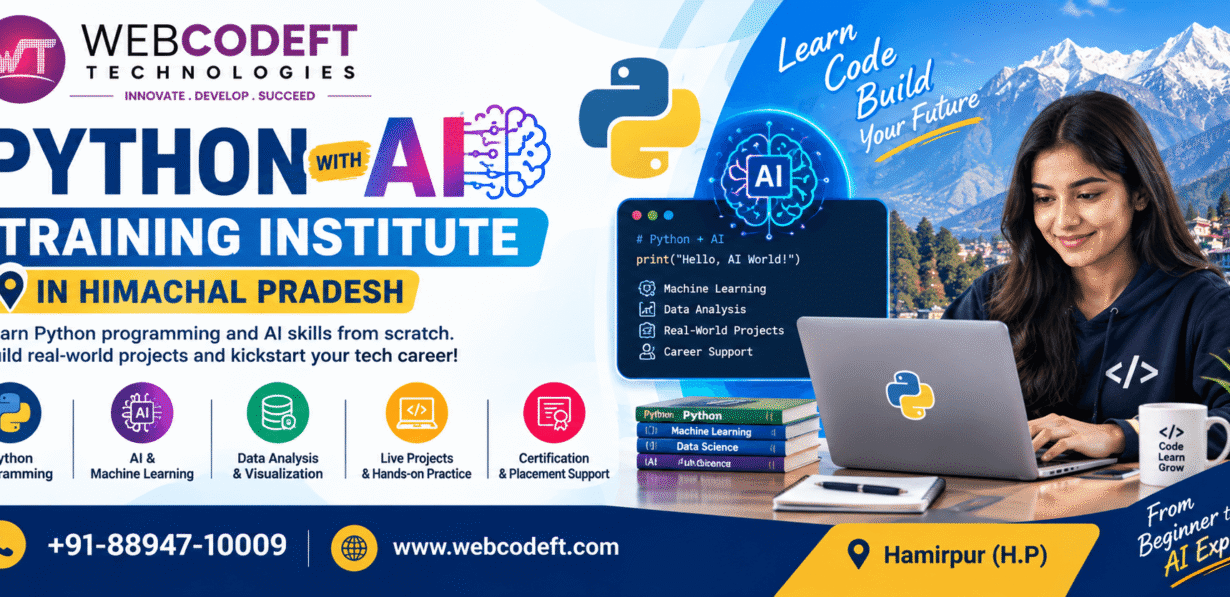
For someone who is completely new to programming, starting with Python AI Training Institute in Himachal Pradesh can be a practical way to understand both programming fundamentals and the growing field of Artificial Intelligence.
Instead of learning programming concepts only through theory, beginners can use Python to create small applications, automate tasks, work with data, and gradually explore AI-powered solutions.
At Webcodeft Technologies, the focus is on helping learners understand concepts practically so they can move from basic programming knowledge toward real-world development skills.
Why Should Beginners Learn Python with AI?
Python is considered beginner-friendly because its syntax is relatively easy to read and understand. This allows new learners to concentrate more on programming logic instead of spending all their time understanding complicated syntax.
Python is also widely used in several technology fields, including:
- Web development
- Data analysis
- Automation
- Machine learning
- Artificial Intelligence
- Software development
- Data science
- API development
Learning Python alongside AI concepts can therefore give beginners a broader understanding of how modern software applications are created.
A good learning path does not require beginners to start with advanced Artificial Intelligence concepts immediately. The better approach is to first understand Python fundamentals and then gradually introduce AI tools, data handling, APIs, and simple AI applications.
What Is Python?
Python is a high-level, general-purpose programming language used for developing different types of software and applications.
Its readable syntax makes it suitable for people who are learning programming for the first time. Python also has a large collection of libraries and frameworks that developers can use instead of creating every functionality from scratch.
For beginners, the learning journey generally starts with concepts such as:
- Variables and data types
- Operators
- Conditional statements
- Loops
- Functions
- Lists and dictionaries
- Strings
- File handling
- Error handling
- Modules and packages
Understanding these fundamentals creates a strong base for more advanced programming.
Python Programming Institute in Himachal Pradesh: What Will You Learn?
A beginner-focused learning program should progress step by step. The purpose is not simply to memorize Python commands but to understand how programming logic works.
- Python Fundamentals
The first stage focuses on the basic building blocks of Python programming.
Learners can start with variables, numbers, strings, Boolean values, lists, tuples, sets, and dictionaries. They can then learn how to make decisions using conditional statements and repeat tasks using loops.
Functions are another important topic because they help developers organize code into reusable blocks.
- Problem-Solving and Programming Logic
Learning programming is not only about writing syntax. Beginners also need to understand how to approach a problem.
For example, before creating a simple calculator, a learner should identify:
- What information the user will provide.
- What operations are required.
- How the program will process the information.
- What output should be displayed.
- What should happen if incorrect information is entered.
This type of logical thinking becomes useful when developing larger applications.
- Working with Data
Python is widely used for handling and analyzing data.
After learning the fundamentals, beginners can explore libraries such as NumPy and Pandas. These tools can help learners understand how structured data is processed.
Basic data visualization can also be introduced so learners understand how information can be represented through charts and graphs.
- Introduction to Artificial Intelligence
Once learners are comfortable with Python fundamentals, they can begin exploring Artificial Intelligence.
AI refers to technologies that enable computer systems to perform tasks that normally require human-like capabilities, such as understanding language, identifying patterns, generating content, or making predictions.
Beginners can start with simple concepts rather than jumping directly into advanced machine learning mathematics.
They can learn the difference between:
- Artificial Intelligence
- Machine Learning
- Deep Learning
- Generative AI
Understanding these terms helps learners develop a clearer picture of the technology landscape.
How Python Is Used in AI
Python plays an important role in AI development because developers can access a large ecosystem of libraries and tools.
Python can be used for:
- Preparing datasets
- Building machine learning models
- Processing text
- Working with APIs
- Automating repetitive tasks
- Developing AI-based applications
- Experimenting with machine learning algorithms
For beginners, the most important objective is to understand how these technologies connect rather than trying to master everything at once.
Using AI Tools to Learn Python
Modern AI tools can also support the learning process.
A beginner can use AI assistants to:
- Understand programming concepts
- Explain error messages
- Generate practice exercises
- Review code
- Suggest improvements
- Explain unfamiliar Python syntax
- Create project ideas
However, AI should be treated as a learning assistant rather than a replacement for understanding.
If an AI tool provides a piece of code, learners should understand what the code does before using it. This approach helps build genuine programming knowledge and reduces dependence on automatically generated solutions.
Practical Projects for Beginners
Projects are an important part of learning programming because they allow students to apply concepts in practical situations.
A beginner learning Python can start with simple projects such as:
Calculator
A calculator project introduces variables, user input, operators, conditions, and functions.
Number Guessing Game
This project helps learners understand loops, conditions, random values, and user interaction.
To-Do List
A basic to-do application can introduce lists, functions, file handling, and application logic.
Expense Tracker
An expense tracker can help learners understand data storage, calculations, and basic reporting.
AI Chatbot
After learning Python fundamentals and APIs, learners can explore how a simple AI chatbot works and how Python can communicate with an AI service.
Text Summarization Application
A beginner-level AI project can demonstrate how Python can send text to an AI service and process the returned result.
Projects like these make learning more engaging because learners can see how individual programming concepts combine to create a working application.
Who Should Learn Python with AI?
A beginner-level Python and AI program can be useful for different types of learners.
Students
Students from computer science, IT, business, science, and other backgrounds can use Python to develop programming and problem-solving skills.
Graduates
Graduates looking to enter technology-related careers can build foundational programming knowledge before moving toward specialized areas.
Working Professionals
Professionals can learn Python to understand automation, data processing, AI tools, or technology-related workflows.
Beginners Without Programming Experience
Python is also suitable for learners who have never written code before, provided they follow a structured learning path.
Python Course for Beginners: How to Choose the Right Learning Program
When choosing a Python with AI Course in Hamirpur, learners should look beyond the course title.
A useful program should provide:
- Beginner-friendly instruction
- Strong Python fundamentals
- Practical coding exercises
- Project-based learning
- Error-solving guidance
- AI-related concepts
- Opportunities to practice
- Structured progression from basic to advanced topics
Learners should also check whether the course provides practical assignments and projects rather than focusing entirely on theoretical explanations.
Why Choose Webcodeft Technologies?
Choosing the right training environment can make the learning process easier, especially for beginners.
Webcodeft Technologies focuses on technology education and practical skill development. A structured approach can help learners understand programming concepts progressively instead of overwhelming them with advanced topics at the beginning.
The goal of a beginner-oriented program should be to help students develop confidence through regular practice, exercises, projects, and concept-based learning.
For learners searching for a Python Course for Beginners in Hamirpur, local training can also provide an opportunity to learn in a structured environment and receive guidance while working through programming problems.
Those looking for AI Course with Python in Himachal Pradesh should consider factors such as curriculum, practical exposure, instructor guidance, project work, and the overall learning approach before selecting a program.
Career Opportunities After Learning Python and AI
Learning Python does not automatically make someone an AI engineer or software developer. Career development requires continuous practice, projects, deeper technical knowledge, and, depending on the role, additional technologies.
However, Python can provide a strong foundation for exploring areas such as:
- Python development
- Web development
- Data analysis
- Automation
- Machine learning
- Artificial Intelligence
- Data science
- Software development
Learners can choose a specialization after developing confidence in programming fundamentals.
Building a Strong Learning Roadmap
A practical roadmap can make the learning process more manageable.
Step 1: Learn Python Basics
Start with syntax, variables, data types, operators, conditions, loops, and functions.
Step 2: Practice Programming Logic
Solve small problems regularly instead of only watching lessons.
Step 3: Learn Data Handling
Explore lists, dictionaries, files, JSON, and basic data-processing techniques.
Step 4: Work with APIs
Understand how applications communicate with external services.
Step 5: Explore AI
Learn basic AI concepts and understand how Python can be used to interact with AI services.
Step 6: Build Projects
Create small applications and gradually increase their complexity.
Step 7: Develop a Portfolio
Keep your completed projects organized so you can demonstrate your practical skills to potential employers or clients.
Frequently Asked Questions
- Is Python suitable for complete beginners?
Yes. Python’s readable syntax makes it a popular choice for people who are starting programming. Beginners should still practice regularly and focus on understanding programming logic.
- Do I need previous AI knowledge?
No. A beginner-oriented program can introduce AI concepts gradually after establishing basic Python knowledge.
- Can I learn Python and AI together?
Yes. A structured Python with AI for Beginners program can first establish Python fundamentals and then introduce AI concepts and practical applications.
- Is Python useful for an AI career?
Python is widely used in AI, machine learning, data science, and related areas. However, an AI career usually requires additional knowledge of mathematics, data structures, machine learning concepts, relevant libraries, and practical projects.
Conclusion
Learning programming becomes easier when beginners follow a clear path instead of trying to learn everything at once. Python provides a strong starting point because it can be used for programming, automation, data handling, web development, and AI-related applications.
A well-structured Python with AI for Beginners learning journey can help students understand programming fundamentals first and then gradually explore modern AI technologies.
Whether your goal is to learn programming, build projects, understand AI, or prepare for future technology opportunities, consistent practice is more important than simply completing lessons.
For learners looking for structured technology training, Webcodeft Technologies can be considered as an option for building practical programming skills and exploring Python and AI concepts in a progressive learning environment.